

You open a chat, see someone type “imao” and pause. Is that a typo? Is it laughter? Is it an insult? The IMAO meaning is actually simple once you see it. It stands for “in my arrogant opinion,” and it is a cheeky twist on the older “IMHO,” which means “in my humble opinion.”
People often mix it up with LMAO because the letters look so close. In this guide, you will learn the exact IMAO meaning, its tone, how to use it, how to reply, and when to skip it.
IMAO Meaning at a Glance
Here is the quick version of the IMAO meaning for anyone in a hurry.
| Detail | Answer |
| Full form | In my arrogant opinion |
| Type | Internet acronym, chat slang |
| Tone | Playful, sarcastic, or sometimes blunt |
| Opposite of | IMHO (in my humble opinion) |
| Often confused with | LMAO (laughing my ass off) |
| Best used in | Casual chats, group chats, comments |
The short IMAO meaning is a joking way to share a strong opinion without pretending to be modest.
What Does IMAO Mean in Chat?
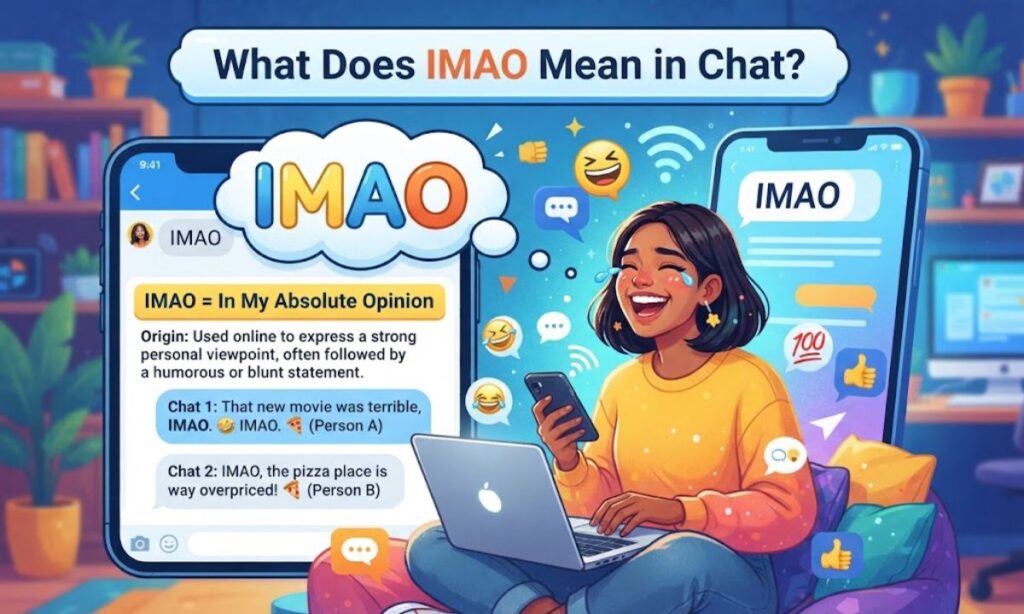
In chat, IMAO tells the reader that you are about to share your view, and you know you sound a bit full of yourself. You are poking fun at the “humble” opinion people always claim to have.
So the IMAO meaning in chat is less about arrogance and more about attitude. You are saying, “I think I am right, and I know how that sounds.”
Example:
“IMAO, pineapple on pizza is the best topping ever.”
The writer is making a bold claim with a wink, not being rude.
What Tone Does IMAO Have?
Tone is where this slang gets tricky. The same three letters can feel warm or cold depending on who types them and who reads them. The IMAO meaning stays the same, but the mood shifts.
It may sound:
- Friendly, when friends joke around
- Sarcastic, when someone mocks a view
- Harsh, when it shuts down another person
Friendly example:
“IMAO, my playlist beats yours every single time.”
Sarcastic example:
“Sure, your plan is great. IMAO, it will fail in ten minutes.”
Harsh example:
“IMAO, you have no clue what you are talking about.”
Imao meaning in chat from a guy
When a guy types it, the IMAO meaning in chat usually leans toward banter. Among friends, it shows up in debates about sports, games, cars, music, and food.
If a guy sends “imao I am the better driver,” he is most likely joking.
IMAO meaning in chat from a Girl
When a girl types it, the IMAO meaning in chat works the same way, but the delivery often feels lighter and more playful. It can be a sassy way to share a view about fashion, shows, or plans.
For example: “imao that outfit was a 10 out of 10.” Gender does not change the IMAO meaning. Tone, emojis, and the relationship between the two people matter far more.
Is IMAO Rude, Funny, or Sarcastic?
It can be all three. That is why context matters so much. The IMAO meaning itself is not an insult, but the way you use it can turn it into one.
It sounds funny when:
- You use it with close friends
- The topic is light, like food or movies
It sounds sarcastic when:
- You say it right after someone shares a weak idea
- The sentence before it sets up a joke
It sounds rude when:
- You use it in a serious argument
- You use it with someone you barely know
Is IMAO the Same as LMAO?
No. This is the biggest point of confusion around the IMAO meaning. LMAO means “laughing my ass off.” IMAO means “in my arrogant opinion.” One is about laughter. The other is about opinion.
Example 1:
“That video was so good, LMAO.” The person is laughing.
Example 2:
“That video was so good, IMAO.” The person is sharing an opinion with a bit of swagger.
Simple rule:
If someone is reacting to something funny, they probably mean LMAO. If someone is stating a view, they probably mean IMAO.
There is a catch, though. Dictionary.com notes that in modern use, IMAO is often just a misspelling of LMAO. The “I” looks like an “L” in many fonts, so typos happen all the time.
How to Tell the Meaning from Context
The IMAO meaning becomes clear when you check what comes before and after it.
It likely means “in my arrogant opinion” if:
- It starts a sentence, like “imao this is the best movie”
- It sits next to a debate or a strong take
- The writer is defending a choice
It may overlap with “LMAO” if:
- It comes right after a joke
- The message has laughing emojis
- The sentence has no opinion in it at all
Example:
“He fell off the chair imao.” No one is sharing a view here, so it is almost surely a typo for LMAO.
How to Use IMAO
Using it well is easy. Put it at the start or end of a sentence that holds your opinion. Keep the topic light and the mood playful.
Here is a simple way to do it:
- Pick a topic you feel strongly about
- Add IMAO before or after your view
- Add a smiley to keep it friendly
Examples:
- “IMAO, Monday should not exist.”
- “Honestly, IMAO, tea beats coffee.”
Imao meaning in gen z

Gen Z loves slang that sounds bold but stays playful. The IMAO meaning in Gen Z circles is the same, though it is far less common than LMAO, so many young users read it as a typo first.
Because of that, Gen Z users often add context, like “imao (in my arrogant opinion).” Use it sparingly and keep the tone light.
When Should You Use IMAO?
Use it to sound confident and funny at the same time. Skip it when the moment calls for care.
Good times to use it:
- Friendly debates
- Group chats with close friends
- Light arguments about food, games, or music
Avoid it when:
- You are talking to a boss or teacher
- The topic is sensitive
- The other person is already annoyed
Examples of IMAO in Real Chat
Seeing the slang in action makes the IMAO meaning stick.
Text message
Sam: Which movie should we watch? Ali: imao the first one is better
Group chat
Hamza: IMAO it is the place near the market. Fight me.
Social media comment
“IMAO, this photo is the best on the page.”
Sarcastic use
Friend: I think I will start studying one hour before the exam. You: imao that is a brilliant plan
Funny or confusing use
Friend: My cat just knocked my coffee off the table. You: imao
The reader may not know if you meant laughter or opinion. When in doubt, spell it out.
IMAO meaning in instagram
On Instagram, the IMAO meaning shows up in comments, captions, and DMs. People use it to share a bold take on a post, a reel, or a story. A comment like “IMAO, this is the best cover of the song” is a friendly way to praise something with attitude.
In comments, keep it kind, because strangers may read it as rude. Fast typing also makes it a common slip for LMAO.
How to Reply When Someone Says IMAO
Your reply depends on the mood. Here are options for different situations.
Friendly reply
“Ha, fair enough.”
Playful reply
“Bold words. Prove it.”
Neutral reply
“Okay, I get your view.”
Disagreement reply
“I see it differently, but I like the confidence.”
Joke reply
“Your arrogance level is impressive today.”
Is IMAO Real Slang or Just a Typo?
Both are true for the modern IMAO meaning. It is real slang, and it is also a very common typo. Early users wrote it on purpose, but today many type it by accident for LMAO.
The easy way to understand it:
- If the sentence holds an opinion, it is the slang term
- If the sentence holds a joke or reaction, it is probably a typo
- If you are still unsure, ask the person
Where Does IMAO Come From?
The story goes back to the early internet. According to Dictionary.com, an early example appeared in a May 1989 Usenet discussion about the Grateful Dead. Through that year it was used only a handful of times, always in debates and arguments.
By 1993, it was widespread in Usenet groups, again mostly in heated topics. In the 1990s and 2000s it grew milder, but never as popular as IMHO. That history explains the modern IMAO meaning. It began as a sharp, ironic jab and slowly turned into a lighter, joking phrase.
IMAO Meaning Across Platforms
The core IMAO meaning does not change, but each app has its own vibe.
IMAO on WhatsApp
Used in friend and family chats for banter. Keep it light.
IMAO on Instagram
Common in comments and DMs, usually to share a bold take on a post.
IMAO on TikTok
Seen in comment sections under debates, rankings, and hot takes. It is often mistaken for LMAO there.
IMAO on Snapchat
Short and casual, so typos are common.
Related Acronyms & Slang
If you like this slang, you will see these terms often too.
| Term | Meaning |
| IMHO | In my humble opinion |
| IMO | In my opinion |
| LMAO | Laughing my ass off |
| LOL | Laughing out loud |
| SMH | Shaking my head |
IMAO vs Similar Words
IMAO vs IMO
IMO is neutral. It simply states an opinion. IMAO adds attitude and humor.
IMAO vs IMHO
IMHO sounds polite, even if the person is not being humble at all. IMAO drops the act and admits the confidence.
IMAO vs LMAO
IMAO shares a view. LMAO shows laughter. Mixing them up changes the meaning of your whole message.
IMAO vs LOL
LOL is a general laugh. IMAO is about opinion and tone.
Can You Use IMAO Professionally?
In most cases, no. The IMAO meaning includes the word “arrogant,” and that does not fit work emails, school messages, or client chats. Even with friendly coworkers, it can sound dismissive.
If you want to share a strong view at work, use clear and polite wording like “In my view” or “I strongly believe.” Keep the slang for friends and casual online spaces.
Common Misconceptions and Mistakes
A lot of people get the IMAO meaning wrong. Here are the usual slip ups.
Common mistakes:
- Thinking it means laughter
- Using it with people who may not know it
- Using it in serious or formal talks
Another myth about the IMAO meaning is that it is always rude. It is not. Among friends, it is usually just playful. You only need to be careful when the audience is unfamiliar.
FAQs About IMAO Meaning in Chat
What does IMAO stand for?
It stands for “in my arrogant opinion.”
Is IMAO the same as LMAO?
No. LMAO is about laughing, while IMAO is about sharing an opinion.
Is IMAO rude?
Not always. It is playful with friends but rude in serious talks.
Is IMAO a typo for LMAO?
Often, yes. Many people type it by accident when they mean to laugh.
Is IMAO the opposite of IMHO?
Yes. IMHO means “in my humble opinion,” and IMAO flips it to “arrogant.”
Can I use IMAO at work?
It is best to avoid it in professional settings.
How do I reply to IMAO?
Match the tone. Joke back with friends or stay neutral with others.
Conclusion
The IMAO meaning is easy once you know it. It stands for “in my arrogant opinion,” and it is a playful, sometimes sarcastic way to share a strong view. It is the cheeky cousin of IMHO and has nothing to do with laughter unless it was typed by mistake.
Read the context, watch the tone, and keep it for casual chats. If you ever feel unsure, a quick follow up question clears things up. Use it with a smile, and you will sound confident, not rude.